Clinical Case: Actively assisting in healing a pressure injury with the Vicair Active O2

By: Megan Ransley

Background

Mr. R has been in a wheelchair for many years, due to an accident that caused a spinal injury. At 26 years old he became quadriplegic at C6 level. He is a very capable manual wheelchair user and is fully independent in his life. He even runs his own business with great success. He has always used a gel-based cushion in his wheelchair. It was given to him by the spinal unit, where fear of pressure injuries
was clearly expressed. Whilst Mr R admits it has been annoying to massage the gel forward every day and the fact that the cushion is relatively heavy, he always considered himself to be ‘a Jay man’.
Like many of his friends that are in a similar position, he could not imagine moving from his cushion, he trusted it and it has done the job for many years. His biggest fear was that a pressure injury might appear if he switched cushions.

The problem

Mr. R has recently developed a red area on his bottom that is not going away. He is getting older and his shoulders are less able to push. Older age also brought along other health issues regarding his kidney function and bowel program. He had spent some time in hospitals and the red area most likely arose from those inpatient stays and a greater amount of passive sitting during that time (whereas he usually moves about a lot in his chair). His occupational therapist wanted to investigate cushions which could provide robust postural support but would be lightweight, easier to maintain and provide the best pressure care.

Implementing Vicair into the seating system

His OT proposed the Vicair Active O2 ( 9cm high) and Mr R was reluctant, but since it was only getting worse he agreed to give it a try. The idea was that the Active O2 would assist in healing his wound and if wanted he could always return to his Jay cushion once the wound was healed. Due to the open weave of the Active O2, it was expected that it would provide a lower temperature to help manage the microclimate of his wound that in turn could speed up the healing. An added bonus was the lightweight nature of the cushion of which his shoulders would benefit.
His first impression of the cushion was very positive, he felt great stability and that he was positioned more upright than on his Jay. He instantly experienced that he was in a better position to push and that it was also easier to do so. His posture is not yet ‘ideal’ but to Mr R it’s the function and the protection that really matters.

Conclusion

A week into the trial Mr R provided us with the following summary:
“The Vicair seating trial has gone extremely well showing a marked improvement over my current Jay Active. Of particular note is a fading of the dark patch and general skin colour improvement over a relatively short period of around 10 days Prior to this the dark patch has remained largely static in size and colour for some months sitting on the Jay Active. The only seating change has been the Vicair I would, therefore, assume its responsibility for the improvement.”

Following this, Mr R went into surgery for a Gall Bladder removal after which he once again gave us his comments, it had now been two months since he swapped to the Vicair cushion:
“Vicair cushion continues to impress, being a little more immobile (pressure relief wise) this last week has seen my butt stay at worst status quo but actually we think continuing to improve.
Given I was up and about the day after surgery I was feeling a bit fragile and unable to perform normal pressure relief regime. The Vicair appears to have given the needed protection even though my movements been greatly reduced…I’m extremely happy as you can imagine, attached pics show botty day before surgery and last night!”

The wound continues to improve, Mr R is delighted with the Active O2 (9 cm) and he now very much considers himself ‘a Vicair man’
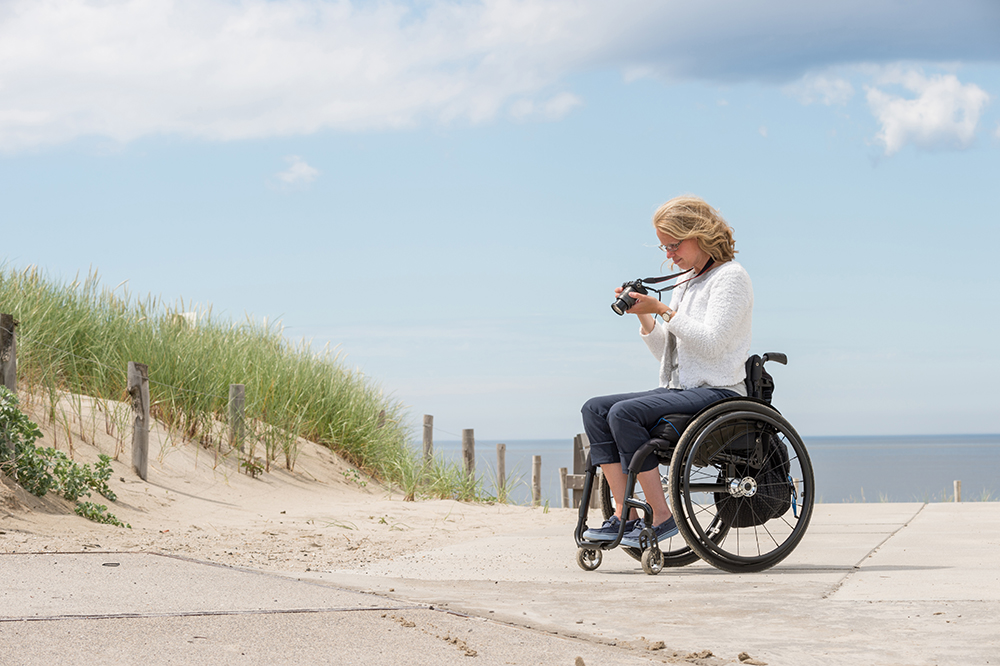
“To me, the Vicair Vector meant no more pain!”

“It’s at the end of the summer of 2006 and I am at the middle of a beach, when I suddenly come to a standstill.”

A very strange experience, because I simply can’t walk anymore. At least, not without pain. As the weather was great, I decided to sit down and wait until I felt better. Maybe I had just strained a muscle? I never started to feel better though. Which meant I found myself stumbling of the beach to get to my apartment. Maybe a hot bath would help, I thought, but it did not bring any relief. Unfortunately I had to spend the rest of my vacation in pain…

Back home the pain did not go away and walking got more and more difficult. Until one morning I woke up and found that both my legs were still sleeping and would not wake up with me (and to this day they are still asleep). I compare it to the strange feeling you get in your legs when you’ve been sitting in a wrong position for too long. Wondering what might be the cause I did start to fear that it would probably be something worse than a strained muscle. Reluctantly I made a doctor’s appointment.

“I was finally tested for and diagnosed with MS (Multiple Sclerosis)”

It was after the holidays, early 2007 when I had my first appointment with a neurologist. It was a relief to find that he took my complaints seriously right away. First he did some tests to rule out other possible causes for my complaints, before I was finally tested for (by use of MRI, Spinal puncture etc.) and diagnosed with MS (Multiple Sclerosis).
During the first year good and bad days fluctuated a lot, but I still could “walk”. Until the day came that I had to face the fact that, when I really wanted to go out and do something, I would need a wheelchair (at first now and then…). I went for my first wheelchair in 2008.

“To me, the Vicair Vector 10 meant no more pain”

By now I was using my wheelchair on a daily basis (both in- and outdoors) and sitting in it started to hurt more and more. To solve this I had been sitting on a Jay Basic cushion, but my technical advisor introduced me to the Vicair Vector 10 cushion. It was love at first sit! No more pain when sitting, the pain in my tailbone disappeared and the cushion offered me so much more stability! Super! Besides that I really love the fact that the Vector is really lightweight.

“A few months ago I met the Vicair team at the MS-day of the Dutch National MS Foundation.”

We agreed to replace the blue SmartCells in my cushions for the new silver-grey versions, in exchange for the right to use the price-winning picture that I had made and that showed my Vector cushion (annual photo contest “I can live with MS”- red.) .The new cells are really great! They are even softer to sit on and very comfortable.

Not only the Vicair cushions are great, Vicair’s customer service is super! This service enhances the quality of the product and results in a positive user-experience. Keep up the good work!”

My wheelchair is not a limitation, it enriches my life!

Even when I was little, I’ve always been pretty active. I’ve had several interests from an early age, including playing the saxophone, riding horses, and dancing. After I studied animal care,  I decided to study on and become a veterinarian for animals with disabilities. As such, it requires physical exertion. As a young dancer, I was incredibly flexible, and it was great for ballet. When I was 22, though, my body could no longer sustain it. I had ‘Patella luxations’ a fancy medical term describing displaced kneecaps. I was afraid of a reoccurrence of the luxation, so in 2014 I had surgery. I was nearly back to normal after nearly 1.5 years of recovery.

“But within a month, my life was flipped upside down after I had finally finished rehabilitating.”

After rounding up my rehabilitation, I had erased all the phone numbers for the hospital and physical therapists from my phone. It felt so good! Until a car disregarded me and my bike five weeks later. When I was struck, my life was completely turned upside down. My whole tibial plateau was fractured because of the event. Instead of getting started with my career-oriented goal in England, I had to reside in a hospital for a month and return to my mother’s home because I required a lot of help and assistance to get better.

“I noticed a friend on Facebook who fractured their ankle and was training for a marathon in a wheelchair.”

I was taken to that idea and bought a wheelchair online. Over the course of the next three months we were training together and in the end, did the marathon and crossed the finish line with smiles on our faces. Soon after I got assigned a wheelchair tailored to my needs. However, after a day of sitting in it, my behind was pretty uncomfortable.

“I got in contact with Vicair at a mobility exhibition.”

At the event, I got to trial several Vicair wheelchair cushions, and the Vicair staff were very helpful. I decided on a Vicair Adjuster O2 and it has made a big difference. Now when I use my wheelchair to workout, I can use all my energy to improve my lap times. It certainly makes a difference having a cushion that shapes your body. My bum is no longer numb, and the tingling sensation is gone, and so is the pain.

“My friends were envious of me because they wanted to rest on my cushion as well.”

I also attended music festivals in my wheelchair. My friends were envious of me because they wanted to rest on my cushion as well. On my previous cushion, I wanted to get out of my wheelchair as soon as possible. I no longer have that desire. I can do anything in my chair, including going out for drinks and snacks and exercising – all while sitting in my own wheelchair with a Vicair cushion. It certainly enhances my life, and I intend to achieve much more in the future.

VIEW OUR SELECTION OF VICAIR WHEELCHAIR CUSHIONS

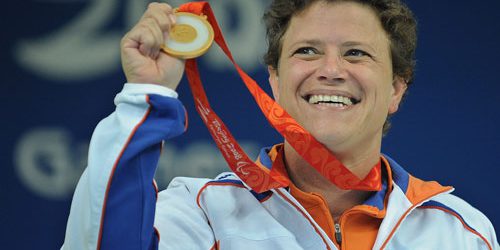
A Paralympic Champion and a Vicair wheelchair cushion… the winning combination

Mirjam de Koning is a former Dutch professional swimmer with a form of paraplegia. She participated in 2 Paralympic Games and 2 World Championships. Where she won a combined 3 Gold Medals, 4 Silver Medals and 3 Bronze Medals. Mirjam held 4 World Records.

Mirjam was born with damaged connective tissue. Over the years her condition deteriorated and Mirjam had to spend most of her days in bed. For this reason she had experimental surgery done in 2000, during which unfortunately a nerve was damaged. This left her with a form of paraplegia and she had to start using a wheelchair. After the surgery, Mirjam decided to play basketball.
However after 4 years, she had to stop as she had too many basketball-related injuries. In 2004 she switched to swimming. What a success story this decision soon became!

A few months before the London Paralympics Mirjam came to Vicair (headoffice in The Netherlands) asking if we could help her during her preparation.

At that time she was suffering from pressure injuries and they were affecting her Paralympic training schedule. Of course we immediately agreed to help and the same day she was using the Vicair Vector cushion. The pressure injuries healed, Mirjam could train more and… she won a Bronze medal on her last Paralympic race ever.
After the London Paralympics Mirjam became a member of the Vicair product development team the same team that developed her Vicair Active wheelchair cushion.

Paralympic Games
Gold medal – first place 2008 Beijing 100m backstroke S6
Gold medal – first place 2008 Beijing 50m freestyle S6
Silver medal – second place 2008 Beijing 100m freestyle S6
Silver medal – second place 2008 Beijing 400m freestyle S6
Bronze medal – third place 2012 London 100m backstroke S6

World Championships
Gold medal – first place 2006 Durban 50m freestyle S6
Silver medal – second place 2010 Eindhoven 50m freestyle S6
Silver medal – second place 2010 Eindhoven 100m freestyle S6
Bronze medal – third place 2006 Durban 100m freestyle S6
Bronze medal – third place 2006 Durban 100m backstroke S6

VIEW OUR SELECTION OF VICAIR WHEELCHAIR CUSHIONS

Equipment funding explained

New Zealand has two main government funding channels. They can be divided into accident and non-accident related conditions.  Alternatively you can purchase direct from a supplier without funding or talk to your therapist about partial funding options by the Ministry of Health.

Accident related conditions – ACC

ACC is an organisation that covers everyone, including visitors, who are injured in an accident in New Zealand. If ACC covered your injury, they can also help you with aids and equipment.

ACC cover most physical injuries if they’re caused by:

  • an accident
  • sexual violence
  • a condition that comes on gradually because of work.

ACC can also cover injuries that are long-term, permanent or that happened at birth. ACC also pays for the aids and equipment you need to recover from your injury. You can use these aids and equipment for as long as you need them to support your injury.

Visit their website for more information: www.acc.co.nz
Phone 0800 101 996 (Monday to Friday, 7am – 7pm)
Email: [email protected]

ACC navigation service: Way Finders www.wayfinders.org.nz
Way Finders is a national navigation service that’s available to anyone who may have questions about ACC or even a specific ACC claim. Our service is available for people who may want an alternative way to interact with ACC rather than deal with ACC directly. Phone: 0800 273 030 Email: [email protected]

Non-accident related conditions – Ministry of Health (MOH)

Is funded by the Ministry of Health. You may be eligible for Ministry of Health funding for specialised equipment if:

You have a disability that will last over six months and result in a reduction of independent function to the extent that ongoing support is required &
You are not an ACC claimant (for that disability).

Equipment can only be provided if an EMS Assessor has identified that equipment is essential for you to:

  • Get around more safely in your home, or
  • Remain in, or return to, your home, or
  • Communicate effectively, or,
  • Study full-time or do vocational training, or,
  • Work full-time, or,
  • Work as a volunteer,
  • Be the main carer of a dependent person.

Funding contribution from the person

If you wish to have equipment which has higher specifications, because it better suit your needs, but is more costly than that recommended by the EMS Assessor. Ministry of Health funding may in some cases only cover the cost of the essential components of the equipment solution. The additional costs of the items must be paid by the person directly to the supplier. This is called Partial funding.

Partial Funding – MOH

Then refer to section 5.7 of the MOH Equipment Manual (as used by therapists) that says:

5.7. Funding contribution from the person If a person wishes to have equipment which has higher specifications and is more costly than that recommended by the EMS Assessor, Ministry funding will only cover the cost of the essential components of the equipment item. The additional costs of the items must be paid by the person directly to the supplier. If there is suitable equipment currently available in the EMS Provider’s reissue store that meets the person’s essential disability-related needs, this equipment will be provided before any new equipment can be purchased.

The equipment issued remains the property of the Ministry. There is no reimbursement of the person’s contribution payable from the Ministry if or when the equipment is no longer required by them is returned to the EMS Provider.

To view the full manual visit https://www.disabilityfunding.co.nz/equipment/equipment-manual


Access to Funding – The process

You will require a needs assessment by a Therapist (Accredited Assessor)

  • ACC; The first approach would be to speak to your health professional i.e. G.P. or case manager for such referral.
  • MOH; Again speak to your G.P., ask for an occupational Therapist referral. In some areas, you can self-refer to this service at your local DHB hospital.


Alternative Funding Options

Advocacy Groups & Grants

If you are not eligible for ACC or Ministry of Health funding and don’t have the means to pay for the equipment yourself, there are various Advocacy Groups that may have loan closets that can supply you with a grant or assist with the payment of equipment.


Cerebral Palsy Association

The purpose of this grant is to assist people with Cerebral Palsy to obtain items of services that mitigate the effects of living with Cerebral Palsy. Grants should assist a person’s independence and or quality of life, or in the case of a child, also that of the parents/family.
www.cerebralpalsy.org.nz/member-services/grants/individual-grants/

Muscular Dystrophy New Zealand

The purpose of this fund is to provide discretionary grants for individuals with a neuromuscular condition to access opportunities and specialised resources that enable them to achieve freedom.
https://www.mda.org.nz/What-We-Offer/Bradley-Jenkin-Memorial-Fund

Lottery grants for people with disabilities

Grants funded by Lotto help to pay for equipment for people with disabilities who want to be more closely involved in their communities.
https://www.govt.nz/browse/health/financial-help/lottery-grants-for-people-with-disabilities/

The Wilson Home Trust

If you are under 22 and live in the Upper North Island, The Wilson Home Trust offers a range of grants that aim to assist and improve the lives of children and young adults with physical disabilities, and their whanau.
https://www.wilsonhometrust.org.nz/grants/


Fundraising Platforms

Fundraising websites can be successful tools for raising the money needed to purchase an Obi.
There are a few online fundraising platform for New Zealanders to choose from:

Once you have created your campaign spread the word through multiple social media channels for optimal response.

SHOP OUR RANGE OF PRODUCTS

A Guide to Pressure Sores

This guide is an introduction, useful for carers, patients, therapists, and nurses. It answers the most frequently asked questions.

What is a Pressure Sore?

Also known as bedsore or decubitus ulcer, it is an area of damaged skin and flesh. Pressure sores may be painful and can take months or, in some cases, never heal. In the worst case a person may require specialist surgery and in cases of infection, death has occurred as a result.

A pressure sore may develop in a matter of only hours if pressure is not relieved. At first, the skin will usually change colour, normally redder or darker. If not treated it will blister and eventually develop into a flesh wound, a deep hole may further develop exposing bone, flesh, and muscle which will become necrotic and die.

The areas most at risk are the sacrum (base of the spine), bottom, hips, heels, ankles, elbows, and shoulders.

These areas usually bear more body weight and the bone is closest to the skin’s surface.


What Causes Pressure Sores?

Factors causing pressure sores are divided into two groups:

Intrinsic Factors

Disease, older age, under or overweight, poor skin condition, limited mobility, incontinence, malnourishment, dehydration and medications.

Extrinsic Factors

Pressure, Shear, and Friction which in turn cause distortion of the skin.

  • Pressure is caused by a person’s weight, as a result, normal blood circulation can be adversely affected, cells are starved of nutrients and waste products are not This ultimately causes damage and tissue death.
  • Shear will only occur when there is It is caused when a person moves their body, but their skin remains motionless against the support surface, i.e when a person slips down in bed but their bottom does not actually move on the sheet. The result can be seen as bruising on the surface of the skin.
  • Friction occurs when a person’s tissue is distorted, but in addition, there is an abrasive action as the skin slides. This may occur when a person is slid across a bed rather than lifted clear.


Who is most at Risk?

Those persons who have prolonged bed rest, are dependent on a wheelchair or sit for long periods in an armchair. Normally their mobility is restricted or difficult. Those who are elderly and weak are also at risk. Other factors include poor blood circulation, illness or disease including diabetes, heart disease, stroke, M.S., etc. Incontinence, poor nutrition, fluid intake, high doses of medication will also significantly increase risk.

Gain professional advice quickly, contact your doctor, or wound care specialist, normally a nurse. You will need treatment. Do not be afraid to be a nuisance. Always ask for help.

It is important to maintain a healthy diet, including plenty of fluids. Use the right equipment to relieve

pressure including the mattress’s contouring homecare-beds, specialist cushions, positioning and pressure reducing supports. For advice ask your occupational therapist or nurse. Try not to worry, pressure sores can be cured if you get the proper treatment and look after yourself.


Practical Tips to Avoid Pressure Sores

If you have been assessed or are worried about pressure sores, prevention is much better than cure. Maintain your mobility as this will ensure good blood circulation. Get out of your bed or chair during the day for a short walk every hour or so.

However, if you are in Bed

  • Change your position at least every 2 hours, more frequently if possible between your back and
  • When lying on your side use pillows to protect your knees and ankles from touching each other.
  • If you have sore heels or your skin is in poor condition you will need heel protectors or a heel support system.
  • To further relieve pressure use a simple bed cradle and a lightweight duvet instead of heavy
  • Use cotton sheets rather than synthetic materials, as your skin is less likely to become hot and
  • Take special care to avoid creases or lumps in your bedding.
  • If you sit up in bed make sure you do not slide on your heels or bottom. Friction or shear will damage your skin.
  • If carers need to transfer or change your position ensure you are lifted correctly, not dragged across the bed.
  • If you are at high or very high risk, you will probably need a specialist mattress and bed. Ask your nurse or occupational therapist for advice.


Which pressure mattress suits you best? CLICK HERE to find out

If you are in an Armchair or Wheelchair

  • It is recommended to relieve pressure every 15 minutes. Take your weight off your bottom by leaning forward while pushing up with your arms or roll from cheek to cheek for a
  • Pressure reducing and positioning cushions are also available. Vicair (available from Morton & Perry) has great range of wheelchair cushions and back supports that feel like you are sitting on air. Ask your Occupational or Seating Therapist for advice.


Which wheelchair cushion suits you best? CLICK HERE to find out

Which backrest suits you best? CLICK HERE to find out

General Tips

  • Check your skin daily for pressure signs. If your skin does not return to its normal colour after you have removed your weight from it, is redder, bruised or blistered seek advice quickly. Don’t be afraid to ask your carer to look for you. Maybe for difficult areas use a mirror.
  • Keep your skin clean and dry. Don’t use talcum powder as this will dry your skin and deprive it of its natural Only use skin creams on your doctor’s or nurse’s advice.
  • When drying your skin pat it dry with a soft towel, do not rub or over massage your skin particularly over bony parts.
  • If you are incontinent ask for assistance from your nurse or Always clean and change your bedclothes if they are wet or soiled.
  • Eat a healthy diet and drink regularly to maintain your Seek advice if you have swallowing or eating difficulties.

Do not worry. Pressure Sores are avoidable and definitely curable with the proper treatment.

Our knowledgeable team are only a phone call away!

Thank you for contacting us.
Your message has been sent and we will be in contact shortly.

If you have an urgent inquiry please call us on:
0800 238 523
Business hours:
Mon – Fri 8.30 am – 5 pm